
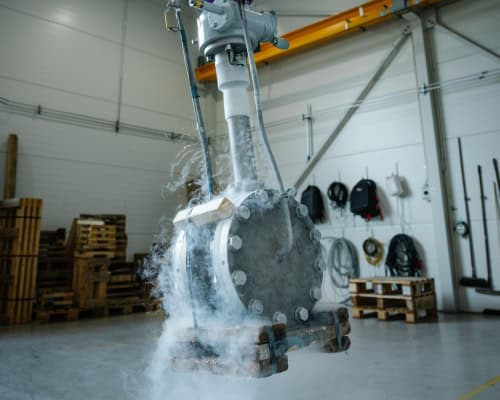
Designing valves for cryogenic service requires a different approach than designing for conventional industrial applications.
In LNG systems, temperatures can reach as low as -196°C. At these temperatures, materials behave differently, tolerances change and design details that may seem minor under normal operating conditions become critical.
For engineers and operators, understanding these challenges is essential when selecting equipment for LNG applications.
Material Selection Becomes Critical
One of the first challenges in cryogenic service is material behavior.
As temperatures decrease, many materials become harder and less ductile. Components exposed to cryogenic temperatures must retain their mechanical properties while maintaining structural integrity under pressure and thermal stress.
Material selection therefore becomes a critical part of valve design. Every component must be evaluated not only for strength, but also for its behavior at extremely low temperatures.
Thermal Contraction Must Be Managed
When temperatures drop from ambient conditions to -196°C, materials contract.
Different materials contract at different rates. If this movement is not properly considered during design, excessive stress, leakage or operational problems may occur.
Cryogenic valve design requires careful consideration of dimensional changes, clearances and sealing systems to ensure reliable operation throughout the full temperature range.
Sealing Performance Under Extreme Conditions
Maintaining a reliable seal is one of the most important functions of any valve.
In cryogenic applications, sealing systems must perform despite significant temperature variations and thermal movement.
The challenge is not only to achieve tight shut-off during initial testing, but to maintain sealing performance throughout years of operation.
This is one reason why sealing technology and seat design receive particular attention in LNG valve development.
Protecting Critical Components
Cryogenic valves often include design features intended to protect critical components from extreme temperatures.
Bonnet extensions, for example, help create a thermal barrier between the cryogenic process and components such as packing systems and actuators.
These features contribute to operational reliability, simplify maintenance and help extend service life.
Experience Matters
While engineering calculations and testing provide essential data, operational experience remains equally important.
Many of the design features found in modern cryogenic valves are the result of lessons learned through decades of LNG service, maintenance and continuous refinement.
At KLINGER Westad, our experience with LNG applications dates back to the 1960s, and each generation of cryogenic valves has benefited from knowledge gained through real-world operation.
Beyond the Specification Sheet
Cryogenic valve performance cannot be evaluated by temperature and pressure ratings alone.
Long-term reliability depends on a combination of engineering, material selection, manufacturing quality, testing and operational experience.
Because in LNG service, reliability is not determined by a single component.
It is the result of every design decision working together.